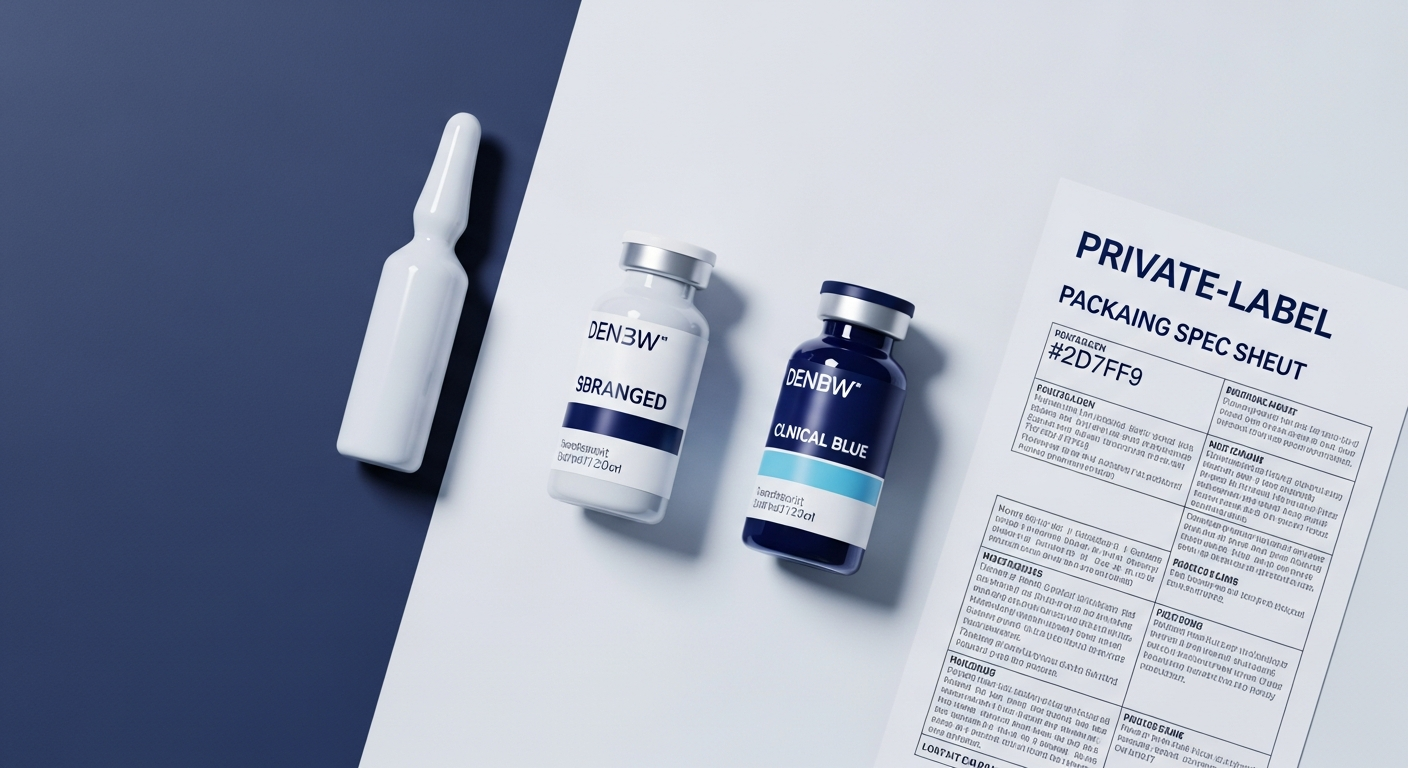
Private-label peptide project review.
Standard catalog SKUs in your label artwork. Custom packaging and custom formulations when you need them. A long-term manufacturing relationship that scales from a 500-unit pilot to a multi-thousand-unit recurring program — without forcing a brand to switch suppliers the moment it outgrows the entry tier.

What “private label” actually means here.
A private-label proposal should specify the entity responsible for manufacturing, filling, labeling and lot release, plus ownership of artwork and formulation. This business is not established here as a manufacturer or contract manufacturer.
White label is a related but distinct model. White-label is a stocked finished good in our standard branding that you re-label and resell. We support both; the choice depends on your launch timeline, packaging budget, and IP strategy. See the breakdown in Private Label vs White Label Peptides.
The three private-label tiers.
Tier 1: Catalog SKU, standard packaging
For a standard-packaging proposal, specify product identity, artwork and required units. Obtain a project-specific minimum, quote and delivery schedule; no manufacturing capacity or fixed turnaround is established here.
Best fit for: brands testing a new SKU, brands that want a real launch on a tight timeline, brands that haven’t yet validated whether custom packaging is going to pay back.
Tier 2: Catalog SKU, custom packaging
For custom packaging, define cartons, inserts, seals and supplier responsibilities. Confirm tooling, minimum quantities, costs and release dependencies in a written proposal before committing to a schedule.
Best fit for: brands that have validated demand on a SKU and are ready to invest in retail-quality packaging differentiation.
Tier 3: Custom formulation, custom packaging
For a proposed custom formulation, confirm feasibility, applicable product requirements, responsible manufacturer and development agreement. Minimum quantities and development and production timing require a project-specific quote.
Best fit for: brands at scale that want a differentiated SKU that competitors can’t replicate by buying from the same supplier you do.
What the engagement looks like.
- Discovery call. Channel fit, regulatory lane, formulation direction, packaging direction, volume target. 30 minutes.
- Quote and term sheet. Written quote with per-unit pricing, MOQ, first-run lead time, and a basic term sheet for the manufacturing relationship. Master services agreement follows if both sides want to proceed.
- Formulation lock. For catalog SKUs, you confirm formulation selection. For custom formulations, we run a 4–8 week formulation-development cycle with your input.
- Artwork and packaging lock. Two rounds of label artwork review included. Custom packaging adds tooling design and proofing.
- Pilot acceptance: agree on production responsibilities, release criteria and the exact evidence required before any material is accepted.
- Re-order planning: obtain written confirmation of inventory and production timing for each proposed repeat order; no standing safety-stock arrangement is established here.
- Annual review. Volume planning, SKU expansion, formulation refresh, packaging refresh. The relationship gets better in year two and year three; that is the design.
What we underwrite on a private-label run.
- Manufacturing evidence: identify the actual facility and review applicable quality records before proceeding.
- Testing evidence: obtain actual identity and purity results and assess whether the methods meet the receiving party's requirements.
- Lot documentation: confirm which records are available for the proposed material before purchasing.
- Lot-coded labels and tamper-evident seals on finished goods.
- Two rounds of artwork review on label work; additional rounds available at cost.
- A named account contact who carries your account from first call through year-three re-order. Not a queue.
Read next
- How to Choose a Private-Label Peptide Manufacturer: A 10-Point Checklist for Brands
- Private Label vs White Label Peptides: What the Difference Actually Costs You
- Wholesale Peptide Supply for Ecommerce Brands
Frequently asked questions
For a standard private-label SKU using your label artwork on our standard packaging, expect a per-unit cost in the wholesale range you would price into a 5x retail markup. The first-run cost includes the production run, label-artwork setup, and lot release. Custom packaging adds a one-time tooling and design cost on top.
First-run timing depends on the proposed product, manufacturer, packaging and release requirements. Obtain a written schedule; no fixed first-run or re-order window is verified here.
Both. The cataloged private-label SKUs are the fastest path to first ship; custom formulations are supported on a project basis, with an additional formulation-development cycle of 4–8 weeks before the first production run. Most brands start in the catalog and add a custom formulation in year two.
For cataloged SKUs, the formulation is ours and you are licensed to sell it under your label. For custom formulations developed for your brand, the IP arrangement is part of the master services agreement — most brands take ownership of brand-specific formulations they fund the development of, with us retaining the underlying manufacturing methods.
Standard catalog SKUs in standard packaging: 500 units per SKU per run. Standard SKU with custom packaging: 1,000 units per SKU per run, primarily because the packaging tooling cost amortizes badly under that. Custom formulation: project-quoted, typically 1,000–2,500 units.
Yes — that is the actual goal of the program. The first run validates the SKU and the relationship. Year two typically involves expanded volume, additional SKUs, and (often) custom formulations or custom packaging. We are built to scale into a long-term CMO relationship without forcing a brand to switch suppliers when they outgrow the entry tier.